
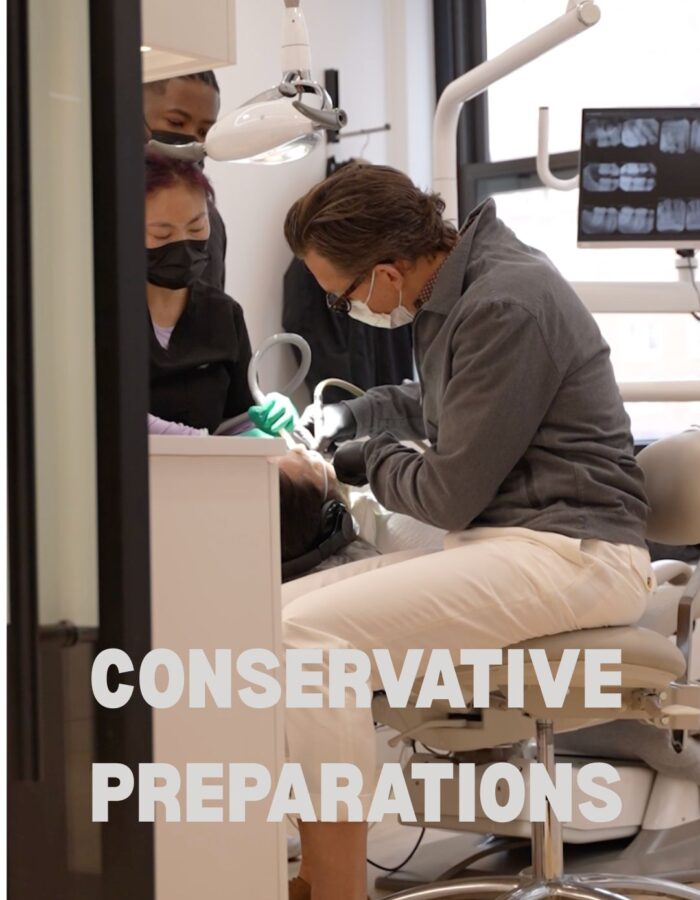
Why the Most Advanced Cosmetic Dentistry Is Now Minimally Invasive
Feb 13, 2026
There is nothing impressive about cutting down a healthy tooth.
It’s fast. It’s forgiving. It creates space. It allows a dentist to mask asymmetry, discoloration, rotation, and proportion with material thickness instead of crafting a smile with design intelligence.
Aggressive preparation is easy because it gives dentists margin for error. When you remove more tooth structure, you create more room to hide imperfections in your work. You can adjust shade with opacity. You can correct angulation with bulk. You can force symmetry with reduction.
The most advanced cosmetic dentistry today is not about how dramatically you can transform a smile. It is about how precisely you can do it while preserving what nature gave you.
The Discipline of Working in Millimeters
Conservative preparation is technically demanding because it eliminates the safety net. When dentists reduce a tooth aggressively for a full-coverage crown, they create thick margins that are easier to conceal. They give the lab ample ceramic thickness to manipulate color and shape while building in forgiveness.
At Apa Aesthetic, we prepare conservatively. Whether for minimal-prep veneers or reductive restorations, we are working precisely and controlled. There is no excess ceramic to compensate for poor angulation or lazy planning. Thin margins require flawless execution.
If preparation is uneven, it will show.
If margin placement is imprecise, it will show.
If design is unbalanced, it will show.
Minimal space demands maximal accuracy. Blindly trusting a dentist from “best dentist near me” could land you in a situation with overprepared teeth. True aesthetic dentistry lives, not in dramatic before-and-afters, but in microscopic decisions that determine whether a smile looks effortless or artificial.
Enamel Is Not Just Structure; It Is Optical Magic
Natural enamel is not a flat, opaque surface. It is translucent. It refracts light. It carries depth and vitality that cannot be perfectly replicated by porcelain alone. When enamel is preserved, we can bond restorations directly to it, achieving superior adhesion and long-term stability. Bond strength to enamel is significantly more predictable than bond strength to dentin. That means margins last longer. Restorations debond less frequently. Sensitivity is reduced.
Beyond biomechanics, enamel provides something even more critical: realism.
The most natural-looking smiles are not created by covering teeth completely. They are created by enhancing what is already there, refining contours, balancing proportions, harmonizing color, without erasing natural anatomy.
When too much enamel is removed, restorations must work harder to simulate what once existed naturally. And simulation, no matter how skilled, is never superior to preservation.
Conservative Dentistry Requires Planning at a Higher Level
Crowns are essential in specific clinical scenarios: teeth weakened by large failing restorations, structural fractures, severe wear, or root canal treatment that compromises internal integrity. In these cases, protection is the priority, and a crown can be the most responsible solution.
But placing crowns on structurally healthy teeth simply because it is easier to control shape and shade is not advanced care.
There is a fundamental difference between protecting a compromised tooth and reducing a healthy one for the sake of convenience. Advanced dentistry understands that distinction and treats it with respect.
Minimally invasive cosmetic dentistry is not just about cutting less. It requires deeper diagnostic work before a handpiece ever touches enamel.
It demands:
- Comprehensive facial analysis to ensure proportions align with the patient’s overall features.
- Occlusal evaluation to understand force distribution and long-term wear patterns.
- Digital smile design or mock-ups to visualize outcomes before irreversible steps are taken.
- Strategic sequencing, sometimes incorporating orthodontics to reposition teeth instead of reshaping them.
When we choose restraint, we often choose complexity.
Sometimes minor orthodontic movement eliminates the need for aggressive reshaping. Sometimes selective enameloplasty achieves balance without restoration. Sometimes composite bonding can solve spacing without sacrificing structure.
These solutions take more thought. More time. More collaboration. All in the name of protecting a patient’s future.
When Margins Are Small, Talent Is Exposed
Large preparations create room to hide mistakes. Small preparations expose them.
When margins are minimal, the transition between natural tooth and restoration must be seamless under magnification. The ceramist must layer porcelain with extreme precision because there is limited thickness to manipulate opacity. Shade selection must account for the underlying tooth color because it cannot simply be masked.
There is no excess ceramic to correct miscalculations. Conservative dentistry removes the buffer. It reveals the level of the operator. And we operate at the highest level.
Longevity Is the Real Measure of Beauty
A smile that looks perfect on delivery but requires replacement in five years is not a success. A smile that preserves enamel, maintains bond integrity, and functions harmoniously within the patient’s bite for decades – that is advanced care.
Every restoration exists within a lifecycle. The more aggressively a tooth is prepared, the more complex future retreatment becomes. Replacement often requires further reduction. Over time, what began as cosmetic enhancement can evolve into structural rehabilitation.
Minimally invasive dentistry interrupts that cycle. It preserves options. It protects the long-term biological integrity of the tooth. It respects that today’s decision affects the next 20 years.
The Standard We Hold
At Apa Aesthetic, conservative preparation is not a compromise. It is a commitment.
It requires higher precision and comfort with working inside narrow margins. The real luxury in cosmetic dentistry is not dramatic alteration; it’s control. It’s knowing exactly how much to remove, and having the discipline to remove no more than that. The most advanced cosmetic dentistry today is minimally invasive not because it is trendy, but because it is smarter, biologically sound, and technically superior.
Anyone can reduce a tooth aggressively and place a crown.
It takes true skill to design a smile when there is no room for error.
Schedule your consultation at Apa Aesthetic New York, Apa Aesthetic Miami, Apa Aesthetic Los Angeles, or Apa Aesthetic Dubai to discover your best smile.
