
Where Dentistry Meets Identity: Designing a Smile That Still Feels Like You
Apr 3, 2026
There is a defining moment within every consultation that distinguishes routine dentistry from something far more considered. It does not begin with shade guides or digital scans, but earlier – quieter, almost imperceptible – when your provider begins to interpret what your smile truly requires.
Not simply in terms of oral health or alignment, but in terms of personality. Presence. Energy.
Teeth are not neutral. They communicate before you ever speak. They shape first impressions, soften expression, and – when approached with intention through modern cosmetic dentistry – become a seamless extension of who you are.
The Idea of the “Ideal Tooth”
Aesthetic dentistry, particularly veneers and smile makeovers, often gravitates toward uniformity – symmetry, brightness, and technical perfection. While these qualities have their place, taken to an extreme they risk producing something overly standardized: a smile that looks and feels impersonal.
The most compelling smiles resist that formula. They are not conventionally perfect; they are precise. Thoughtfully designed to complement the face, enhance natural features, and maintain harmony with the patient’s overall aesthetic.
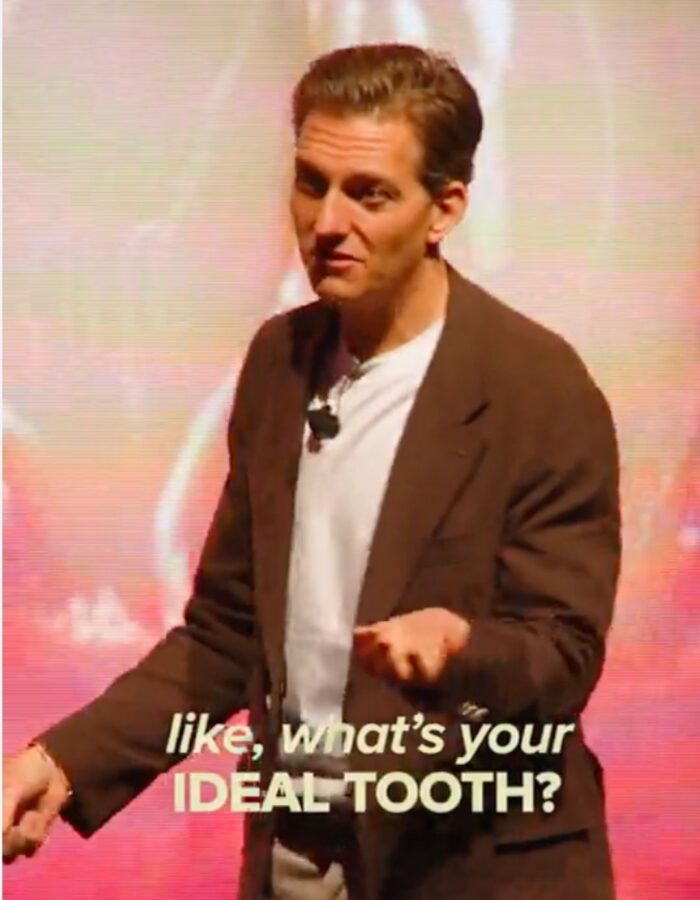
This is where the concept of the “ideal tooth” becomes essential.
When designing a custom smile with comprehensive cosmetic dental treatment. a thoughtful provider begins by identifying a reference point within the existing dentition. An element that already works. That feels inherently right.
This “ideal tooth” is not about perfection, but direction. It offers insight into where the smile is naturally inclined to go, informing every decision that follows in the smile design process.
Within every smile, there are details worth preserving.
A slight rotation that adds character.
A softness along the incisal edges that conveys ease.
A more dominant central incisor that lends structure and confidence.
Not all irregularities are meant to be erased in pursuit of “perfect teeth.” Some are instructive. They act as subtle indicators, guiding the evolution of the smile rather than being indiscriminately corrected.
When these nuances are recognized and respected, cosmetic dentistry shifts from transformation to refinement. The goal is not always to create an entirely new smile, but to elevate the one that already exists.
Reading the Arch, Not Just the Teeth
A smile is not a collection of individual teeth. It is an arrangement, an arch form that dictates flow, proportion, and balance.
Where does the peak of the smile sit?
How do the teeth follow the curvature of the lower lip?
Is the arch broad and open, or narrow and contained?
These considerations are foundational in advanced smile design and veneer treatment planning. They determine how a smile moves, how it frames the face, and how natural it ultimately appears.
Understanding arch form allows for something deeper than correction. It allows for translation.
If a patient has a naturally wide, expressive smile, flattening that into something overly controlled, even with technically “perfect” veneers, can strip away presence. If someone has a softer, more delicate arch, overbuilding structure can feel unnatural, no matter how white or straight the teeth may be.
True aesthetic dentistry respects the architecture of the mouth as much as the appearance of the teeth themselves.
Personality, Embedded in Enamel
Every patient walks in with a history written into their teeth, not just in wear patterns or alignment, but in expression.
There are smiles that feel playful – marked by slight asymmetries and softer edges.
There are smiles that feel powerful – defined by clean lines and strong central incisors.
There are smiles that feel understated, refined, and deeply personal.
These qualities are not accidental. They are part of how a person presents themselves to the world.
The responsibility of cosmetic dentistry at the highest level is not to erase these characteristics, but to recreate them more intentionally: brighter, healthier, and more balanced.
When you begin to ask, “What is a tooth in this person’s smile that emits personality?” you isolate what truly matters. And once identified, the question becomes: how do we preserve and replicate that essence in the final result?
Replication, Not Reinvention
The difference between good dentistry and exceptional dentistry lies in this idea of replication.
Anyone can create straight, uniform, white teeth. But a smile that feels like it has always belonged to the patient, that requires restraint, observation, and precision.
Especially in smile makeover cases, where the margin for error is minimal, the goal is not reinvention. It’s refinement.
Replication is about taking what already works and elevating it through thoughtful design and advanced dental techniques.
It may mean preserving the natural length relationship between the central and lateral incisors to maintain softness.
It may involve keeping a slight irregularity in alignment to retain character.
It may require adjusting proportions without disrupting the original rhythm of the smile.
These decisions are subtle, but they are everything.
When cosmetic dentistry is overdone, even with the highest quality materials, the result can feel generic. When a smile becomes generic, it disconnects from the person wearing it.
The Emotional Outcome
When patients say, “I want better teeth, but I still want to look like myself,” they are not resisting change. They are protecting something intangible.
Familiarity. Identity. Recognition.
The most successful smile transformations are the ones that feel effortless. Where the improvement is undeniable, but not immediately obvious.
People notice something different. More polished. More confident. More elevated.
But they cannot quite place why.
That is the power of designing with personality in mind.
Elevating the Standard
Today, it is no longer enough for teeth to be straight and white. A truly successful smile design must be intentional, individualized, and rooted in both function and aesthetic harmony.
This requires a more thoughtful approach to cosmetic dentistry. One that values nuance as much as outcome.
What is the ideal tooth for this patient?
How does their natural arch inform the design?
Which characteristics of their existing smile should be preserved at all costs?
When these questions guide the process, the result is not just a better smile, it’s a more authentic one.
The best aesthetic dentistry is invisible in its effort. It does not announce itself. It allows someone to walk into a room and be seen more clearly, not because their smile has changed who they are, but because it has revealed them more fully. That is the difference between transformation and translation.
It’s where dentistry, at its highest level, becomes something far more than clinical.
It becomes personal.
Start Your Journey at Apa Aesthetic
Are you tired of searching “Bonding vs. veneers,” “best dentist near me,” and “veneers that don’t look fake,” it may be time to move beyond research, and into a more considered approach. At Apa Aesthetic, the process begins with intention. Start your smile makeover journey today with a consultation.
