
How an Imbalanced Bite Can Affect Your Entire Body
May 8, 2026
“Why does my jaw hurt?” “Why do my teeth feel uneven?” “Why do I wake up with headaches or facial tension?” If you find yourself searching for answers to questions like these, you are not alone. Millions of people live with chronic discomfort, ranging from a dull ache in the temples to a clicking jaw, without ever realizing that the culprit isn’t just stress or lack of sleep. Often, the root cause lies in the very foundation of your oral health: your bite. In the world of modern restorative dentistry, we view the mouth as a complex, integrated system. Your teeth, jaw joints, and facial muscles are designed to work in perfect harmony. When your bite is balanced, the pressure of chewing and clenching is distributed evenly. However, when even a single tooth is slightly out of alignment – a condition known as malocclusion – it creates a ripple effect that can impact your entire body’s sense of wellness.
The Chain Reaction of a Misaligned Bite
Think of your bite as the alignment of a high-performance vehicle. If one wheel is slightly off, the car might still drive, but the tires will wear down prematurely, the suspension will strain, and eventually, the entire frame begins to suffer. Your jaw operates on a similar principle. When your upper and lower teeth don’t meet correctly, your jaw muscles must overcompensate to find a comfortable resting position. This constant muscular effort leads to what many patients describe as “facial fatigue.” Because the muscles are never truly at rest, they become overworked and inflamed. This tension doesn’t stay confined to the mouth; it travels upward into the temples, causing chronic tension headaches, and downward into the neck and shoulders. What feels like a muscular problem is often a structural one, originating from the way your teeth interlock.
Beyond the Teeth: Sleep, Tension, and TMJ
An imbalanced bite is frequently the silent driver behind Temporomandibular Joint (TMJ) disorders. The jaw joint is one of the most complex joints in the body, capable of both sliding and hinge-like movements. When a bite is uneven, the joint is forced out of its natural socket, leading to the clicking, popping, or painful locking that many patients experience. Over time, the mechanical friction can wear down the delicate cartilage within the joint.
Your bite can also impact your sleep quality. Many patients who suffer from an imbalanced bite subconsciously grind or clench their teeth at night – a condition called bruxism – as the brain attempts to “grind away” the interference that is preventing the jaw from resting. It leads to a cycle of poor sleep, morning jaw soreness, and a sense of exhaustion that persists regardless of how many hours you spend in bed.
The Hidden Cost of “Toughing It Out”
It is easy to dismiss a clicking jaw or occasional headache as a byproduct of a busy lifestyle. However, bite issues are progressive. When the teeth do not meet properly, the enamel – the hardest substance in the human body – begins to bear the brunt of uneven forces. This often results in worn-down “flat” teeth, jagged edges, or even mysterious chips and cracks in healthy teeth. Beyond the physical wear, there is an aesthetic component to consider. An imbalanced bite can lead to facial asymmetry over time. As muscles on one side of the face become more developed due to overcompensation, or as the height of the teeth diminishes from grinding, the lower third of the face can appear collapsed or prematurely aged. Correcting the bite is as much about preserving the youthful structure of your face as it is about dental health.
Modern Solutions for Lasting Comfort
We no longer have to rely on guesswork to diagnose these issues, and neither do our patients. Modern restorative dentistry utilizes advanced digital imaging and comprehensive treatment planning to map out exactly how your jaw moves. Once the source of the imbalance is identified, we can create a customized roadmap to restore harmony to your smile.
While orthodontics and night guards play a vital role, restorative treatments like custom-crafted crowns and porcelain veneers are often the “secret weapon” for correcting a bite that has been compromised by years of wear.
Why Veneers Are a Game-Changer for Bite Alignment
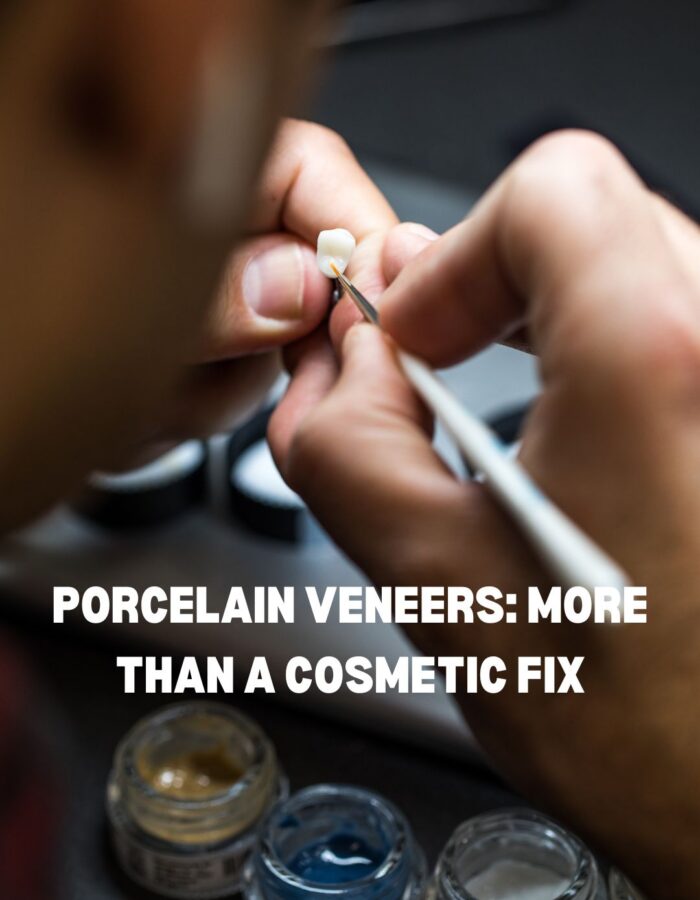
Veneers are much more than a cosmetic upgrade; they are a functional tool used to “reboot” your entire oral system. When teeth are ground down or chipped due to an uneven bite, they lose the height and surface anatomy necessary for the jaw to rest in its natural, neutral position.
Veneers allow us to:
- Restore Vertical Dimension: By adding back the precise amount of height lost to grinding, veneers help decompress the jaw joint and relax overworked facial muscles.
- Correct Tooth Surface Anatomy: We can reshape the biting surfaces so that the upper and lower teeth interlock correctly, preventing the “sliding” that often leads to TMJ pain.
- Strengthen Compromised Structure: Modern porcelain is incredibly durable, reinforcing teeth that have been thinned out or cracked by uneven pressure.
- Provide Immediate Symmetry: Unlike long-term orthodontic treatments, veneers can often correct minor misalignments and close gaps in just a few appointments, providing both functional relief and a balanced aesthetic.
In more complex cases, a full-mouth rehabilitation – combining porcelain veneers with crowns, bridges, or other restorations – ensures that every aspect of the oral environment is optimized for both function and beauty. Whether it is protecting your system from the forces of nighttime clenching or shifting the foundation into the correct position, these modern tools allow us to build a smile that feels as good as it looks.
A Foundation for Wellness
Correcting a bite imbalance is one of the most rewarding journeys a patient can take. It is a transition from living with managed discomfort to experiencing true functional freedom. By aligning the bite, we aren’t just fixing teeth; we are reducing chronic pain, protecting your natural dental anatomy, and supporting a higher quality of life through better sleep and reduced tension.
Take the First Step Toward Relief
If you have been living with persistent jaw pain, frequent headaches, or notice your teeth are wearing down, your bite may be searching for a balance it cannot find on its own. Schedule your consultation at Apa Aesthetic New York, Apa Aesthetic Los Angeles, Apa Aesthetic Miami, or Apa Aesthetic Dubai, and together, we can discover the root cause of your discomfort and build a foundation for a healthier, more comfortable future.
At Apa Aesthetic, we address form and function, helping you to breathe, sleep, and smile better through restorative excellence.
